

Ryan Burge, amplifying the results of the longstanding Pew Religious Landscape Survey, wants us to pay closer 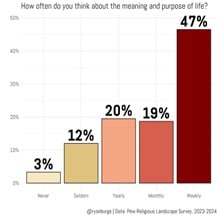 attention to the data on belief in the United States—and especially the data on what underlies belief. How often are people thinking about the meaning and purpose of life?
It turns out that two-thirds of us think about the meaning and purpose of life at least monthly. In fact, according to several other surveys taken in the last few years, we think about the meaning and purpose of life as much as we think about money or politics.
Notably, this kind of existential reflection persists across all generations. People born in the 2000s are about as likely to think about the meaning and purpose of life as people born in the 1940s—or people born in between.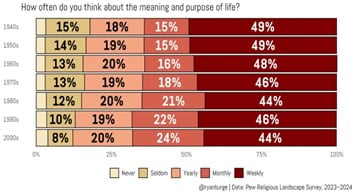
On a recent TMC podcast, Robb Webb of the Duke Endowment talks about a large weekend gathering for college students that he attended this past February in the Northeast. The gathering was focused on Christian faith. Robb was struck by the students’ presence and attentiveness, and he began probing to learn more:
[T]hese are college students who’ve come to Christianity as freshmen, sophomore, juniors. They’re all in. And I was asking (this is unofficial and non-scientific, but I asked a series of questions like),“Why did you come to this event?”
And the general sense was, “We want to explore the big questions of life.”
And my question back was, “Well, what are the big questions of life?”
And they said things like, “Life, death, and why am I here?”
And I said, “Well, what about the environment? What about social justice? What about these sorts of things?”
And they said, “You know, we can get that anywhere on campus. But the church is the only place that can tell us about life, death, and ‘why are we here?’. And more importantly, how on earth could we possibly understand justice of any kind – economic, social, environmental – if we didn’t understand the life, death, and resurrection of Jesus Christ?”
Reflecting further, Robb ponders what this means for the church today:
So, on one side of the equation, I am thrilled that our younger generation is asking that kind of question. And on the second side of the equation, … I’m worried … that our churches aren’t ready for that. These young folks are coming in with deep theological questions. They’re not interested in the mechanics of the church. They want to know, “What does Jesus have to say to my life?”
Robb’s reflection, placed side by side with the data on meaning and purpose, offers a gift of clarity and a crisp question for ministry leaders, including your own church board. If we are not dealing with life, death, and the “why am I here” question – then, why ARE we here?
When do you find yourself thinking about the meaning and purpose of life? Are there specific conditions or situations that seem to stimulate that?
Any guesses on why the act of thinking about the meaning and purpose of life has remained so durable from generation to generation?
What strikes you most about the story that Robb Webb shared on the TMC podcast?
What scripture would you pair with this story and the data above to have a conversation with your church board?
As you look over the activities of your congregation, which ones most address the questions of those college students?



No Comments