


There is a moment early in Tennessee Williams’ A Streetcar Named Desire when Blanche DuBois, fragile and frightened, asks that a bare lightbulb be covered with a paper lantern. It is one of the theater’s most economical images: a person so worn down by the world’s judgment that she must mute the very light in order to stay in it. Blanche is not hiding in darkness. She is doing something subtler and sadder — she is dimming herself just enough to survive.
Sherwin-Williams recently published a chart tracking the most popular exterior and interior home colors from the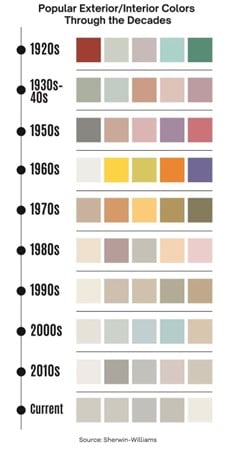 1920s to the present. This is a chart worth sitting with for a minute.
The early decades show a world willing to commit — deep reds, forest greens, terracotta, gold, saturated blues, the confident orange of a mid-century kitchen that knew exactly what it was.
Then something happens. The 1980s begin a long retreat. The 1990s go nearly beige. The 2000s add pale blue and sand. The 2010s turn gray, off-white, and grayer still. And the current colors — the colors Americans are choosing right now for the inner and outer walls of their homes—are so drained of pigment that one swatch is almost indistinguishable from the next.
We are hanging paper lanterns over our lives and calling it taste.
This is not merely an aesthetic observation. Something is being said, culturally and spiritually, about what we have learned to want from our homes and perhaps from ourselves: invisibility dressed as sophistication, withdrawal marketed as calm. The home, after all, is not just shelter. It is self-expression. It is the face we show the street.
Sinclair Lewis saw this coming a century ago. His novel Babbitt gave us a man thoroughly convinced that his conformity is actually success, that his sameness is actually taste, that the cage he lives in is actually a very nice house in a very good neighborhood. Babbitt never once sees the bars on his cage. What makes Lewis’s portrait both memorable and devastating is not that Babbitt is malicious — it is, simply, that he is afraid, and his fear has been so long domesticated that he has mistaken it for preference. He doesn’t know he has dimmed himself. He thinks he has refined himself.
This is a particular danger for the church. It is not that boards and congregations set out to become beige. It is that beige-ness accumulates quietly, wall by wall, decision by cautious decision, each one reasonable in isolation — don’t say that, it might offend someone; don’t try that, it might fail visibly; don’t be so specific, it might exclude someone. And one day you look up and the walls are the color of nothing, and you call it wisdom.
Some institutions over-correct — they find one vivid color and paint everything with it, mistaking volume for vitality, intensity for fullness. But one color is not a full palette. One note played at maximum volume is not a symphony. It is an alarm, and an alarm, however urgent, eventually becomes noise that people learn to ignore or flee. A church that has collapsed its full palette into a single hue — whether that hue is political outrage, or therapeutic comfort, or doctrinal purity — has not escaped the paper lantern. It has simply replaced Blanche’s quiet dimming with a different kind of distortion.
The goal is not loudness. The goal is the full palette.
Which brings us to a hillside in Galilee, and Jesus, who apparently thought a lot about light. In Matthew’s Sermon on the Mount, Jesus says:
You are the light of the world. A city built on a hill cannot be hid. No one after lighting a lamp puts it under the bushel basket, but on the lampstand, and it gives light to all in the house. In the same way, let your light shine before others, so that they may see your good works and give glory to your Father in heaven.
Jesus does not say become a light. He says: you are the light. The vividness is already there, already given, already true. The question is not whether you have color — you do, the creation put it there — the question is whether you will cover it.
And notice the scale of the image. A city on a hill. Not a candle in a corner, not a tasteful accent wall, not a carefully managed institutional presence. A city, visible from a distance. Particular. Unmistakable. The kind of thing you cannot look at and confuse with the landscape.
The church board that governs in that spirit asks not only, will this be safe? It asks first, will this be vivid? Will it be true to the magnitude of our faith? Will we be helping other people see in its light? Or have we put a basket over our light and convinced ourselves we are being prudent?
Blanche DuBois does not get a happy ending. She retreats so far into her muted light that she loses contact with reality entirely. Near the end of Streetcar, Blanche explains to Mitch that she doesn’t tell the truth, she tells what ought to be true. That’s a character who has learned that her authentic self is too vivid for the world, so she performs a muted, acceptable version instead. Williams is not subtle about the cost of self-concealment. It costs, eventually, the self.
Jesus declared, You are the light of the world. Not the paper lantern. Not the ambient glow. Not the tasteful accent. The light itself.
We don’t dare cover it.
Any thoughts on why the preferred paint colors of Americans have grown so muted in recent decades?
What colors have you considered most recently for your own home? What did you end up choosing?
What do you make of Jesus’ call to be like a city on a hill?
When have you felt that your congregation was “the light of the world?” What was happening?
Do you remember a church board meeting when board members asked of something, will this be safe? How about a meeting where board members asked, will this be vivid?
What would it be like to make that second question (will this be vivid?) your board’s first question about everything you decide?




Albert
Posted at 07:44h, 12 MarchWhat an excellent article and exposition!