


Less than halfway through Act One of Arthur Miller’s Death of a Salesman, Willy Loman’s wife Linda, seeing him stumble toward oblivion, cries out forcefully to their two distracted sons:
I don’t say he’s a great man. Willy Loman never made a lot of money. His name was never in the paper. He’s not the finest character that ever lived. But he’s a human being, and a terrible thing is happening to him. So attention must be paid.
In the same spirit, toward the end of the play Willy exclaims to his son Biff, in words saturated with despair: “I am not a dime a dozen. I am Willy Loman.” The irony is thick. He’s asserting his singularity through his name. I am Willy Loman. But Willy Loman is not a name that the larger world recognizes, not a name that was ever “in the paper.” The name itself has become the argument against him.
We church folk may warmly affirm the sentiment that every person matters. Our politics, our world view, and our preferences suggest otherwise.
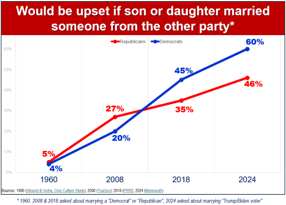 As a culture, we have gone from suspicion of “the other” to downright hostility.
This chart will come as no surprise to any pastor or church board attempting to navigate life as a faith community in 2026. The political divide that has been exploited by heated rhetoric grows wider every year—and it has infected attitudes across other divides as well.
Ryan Burge, a mainline pastor whose ‘data on religion’ we often use in this space, puts it plainly: “I can’t tell you how many times evangelicals told me that I wasn’t a real Christian.”
Flip the view to “the other side” and the suspicion or judgment falls equally harsh. That’s the reality today. We don’t see people; we see allies and opponents, those who align with us and those “others.”
Claims about who is or isn’t “a real Christian” are an express lane to further fracture in the church. If you can “disqualify” any person or group, you no longer have to care for them, let alone pay attention to them.
Your church board has a high challenge and a God-given opportunity to act intentionally in this cultural chasm by attending to others in their singularity, by receiving each person one-by-one.
Decades ago, “the program church” was perceived as an effective way to attend to one another in a congregation. Identify categories of people (youth, children, singles, older members), put them together in groups, and offer a program to keep them engaged! While not intended as such, this approach taught church leaders to see people as members of groups, determined by their demographics and specific interests. Over time, it eroded the one-by-oneness that we all yearn for, especially in a society full of people suffering from increasing isolation.
When Death of a Salesman premiered in Philadelphia in 1949, the fall of the final curtain was met with a long, tense silence … followed by thunderous applause. And then something happened that surprised even Arthur Miller, who thought he had just delivered a hard-hitting critique of American capitalism. Audience members wept openly, and, refusing to leave, they “started talking to complete strangers about how deeply affected they had been by the play.” Miller was surprised yet again when he brought the play to Beijing in 1983—and there too, in communist China, audiences resonated deeply and emotionally with its themes of an individual human life to which attention must be paid. As a Wall Street Journal commentator at the time observed:
The whole episode is a compressed parable about what it means for a story to be true — not American or Chinese, not capitalist or communist, but human. Willy Loman crossed the Pacific carrying a suitcase full of broken dreams, and people who had never heard of a salesman wept anyway.
Can the church do what is necessary to receive each person, one by one by one by one, broken dreams and all, even if that proves to be difficult not only in terms of ideology but in terms of efficiency? If we can, it will yield rich dividends for church as a lived community. Because, in truth, no one is a dime a dozen, and every person has God’s attention – and deserves ours, too.
What is Linda Loman’s argument for attending to her husband Willy? Why must attention be paid?
What strikes you most about the chart shared above? What, if anything, surprises you about it?
How do you, as a church board, think and talk about the people in your congregation? What categories do you use to group them, and to what end?
In what ways do these categories help you do your work together? How might they also be getting in the way of your ministry?
What could you put on your church board agenda for your next meeting that might help you practice a little more one-by-oneness instead?



Anonymous
Posted at 10:41h, 18 AugustI would recommend that every year, each Church member is paired up with someone they don’t know to sit with and everyone has to do their homework, an essay about the sermon and how we applied it each week and grade each other’s home work and then the homework is given to a group leader who grades it and then it is brought before the elders. Thus, you know if the teacher/preacher is doing their job and what Church members need pouring into, and what members have something worthwhile that is applied to the Church. The applied part of the homework is how we carry what we’ve been given, carrying it outside of the Church, pouring into our families and communities.