
About once a year we find ourselves turning to the world of sports for an apt insight into the work of church boards. Our sports offering this year comes from Rick Pitino, storied basketball coach with over 900 wins to his career, now coaching the St. John’s men’s team.
Pitino posted the following a couple of weeks ago before his team took on UConn:
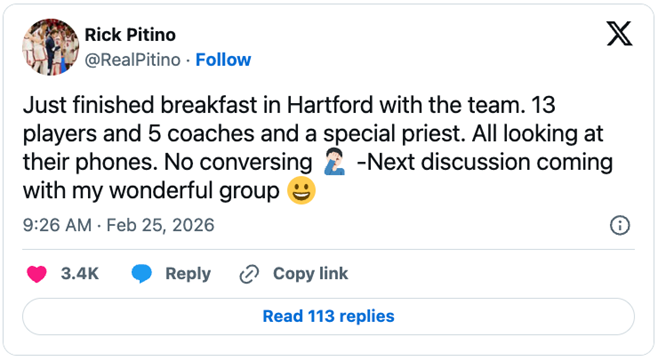
The game against UConn was one that Pitino and the team would rather forget. The next morning, The Athletic tweeted the following account of the contest, alongside Pitino’s post:
A harmless tweet about a disconnected group of 18-23 year olds preceded disaster for St. John’s on Wednesday night. The Johnnies were ran out of the gym in Hartford, losing to UConn by a score of 72-40. The numbers are staggering. It’s the lowest point total ever by a Pitino-coached team. UConn held St. John’s without a field goal for the final 17 minutes and 28 seconds of the game. They missed 24 straight shots!
Pitino’s observation and the team’s painful performance might be best understood through
the research of social psychologist Jonathan Haidt. Speaking at MIT earlier this month, Haidt connected declines in humanity’s “attentional ability” with our use of smartphones and social media. MIT News offered this helpful summary of Haidt’s lecture.
[Haidt] presented a forceful analysis of the damage smartphones and social media are doing to our cognition, our civic fabric, and our children’s wellbeing, while calling for renewed action to ward off their effects.
“Around the world, people are getting diminished,” Haidt said. “Less intelligent, less happy, less competent. And it’s happening very fast … My argument is that if we continue with current trends as AI is coming in, it’s going to accelerate. The decline of humanity is going to accelerate.”
As Haidt has continued to examine the effects of social media on society, he has started focusing on additional issues. Our inability to put our phones away, our compulsion to check social media, and the way we spend hours a day watching short-form videos, may be causing problems that go far beyond any rise in anxiety and depression.
“It turns out, [anxiety and depression are] not the biggest thing,” Haidt said. “There’s something bigger. It is the destruction of the human capacity to pay attention. Because this is affecting most people, including most adults. And if you imagine humanity with 10 to 50 percent of its attentional ability sucked out of it, there’s not much left. We’re not very capable of doing things if we can’t focus or stay on a task for more than 30 seconds.”
Our forebearers in faith saw this coming — not the smartphones, but the distractedness. Jesus, in the Sermon on the Mount, points to the lilies of the field not merely as a lesson about anxiety, but as an invitation to a different quality of attention altogether. Consider the lilies, which in its original context means something closer to study them, be absorbed by them. The lilies are not distracted. They are fully what they are, fully present to the life moving through them. And then comes the pivot: Seek first the kingdom — which is to say, order your attention around what actually matters.
Paul writes to the fractious, distracted church at Corinth — a congregation splintering into competing factions and competing loyalties — and offers this image: the body. Not a committee. Not a coalition. A body, in which “the eye cannot say to the hand, ‘I have no need of you,’ nor again the head to the feet, ‘I have no need of you.'” The genius of this image is that it assumes attentiveness. The eye must actually look at the hand to recognize its necessity. Members must pay attention to one another to function as a body at all.
What matters, it turns out, is that we pay attention to one another. And to the work we can do together.
This is what Haidt’s research reveals about a peril we have not yet fully named. It is not only that we are less intelligent, less happy, less capable of sustained thought. It is that we are losing the capacity to see one another — to notice the person across the room, to register the feelings in a face, to be drawn out of our own fragmented interior world into genuine encounter. The body of Christ cannot function when its members cannot perceive each other. And a world in serious trouble — the trouble Haidt himself is charting — will not be met by isolated individuals staring at screens, however individually well-intentioned.
Consider the lilies of the field. And consider your fellow church board members in the same way. Study them, be absorbed by them. What is the life that blows through them? What troubles them? And what is the work you can do together?
What are you noticing these days about the ways people pay attention to others in public places?
Where do you see people actively refusing to attend to one another? What are the signs of that refusal? What are the fruits?
Where do you see people paying attention to one another? What are the signs of that attention? What are the fruits?
What are you currently doing, as a church board, that hinders members from paying close attention to one another during meetings? Any thoughts on what you could do to change that?
What could you do, as a church board, to help your congregants better perceive one another as part of the same body? What is getting in the way, and how can you change that?

No Comments