
In a recent TMC podcast, Allison Norton and Scott Thumma of the Hartford Institute for Religion Research highlighted data showing that congregations’ openness to change rose during the pandemic. This makes sense. Every faith community had to try lots of things they had never done before, from meetings on Zoom to non-traditional forms of gathering, doing communion, and passing the peace. And then, as the pandemic faded, the data on openness plateaued and even declined. It was as if congregations had hit the wall and reversed course, saying in effect, “this far and no more.” But wait! By 2025 the will to change had ticked up again. Openness is once more in the air.
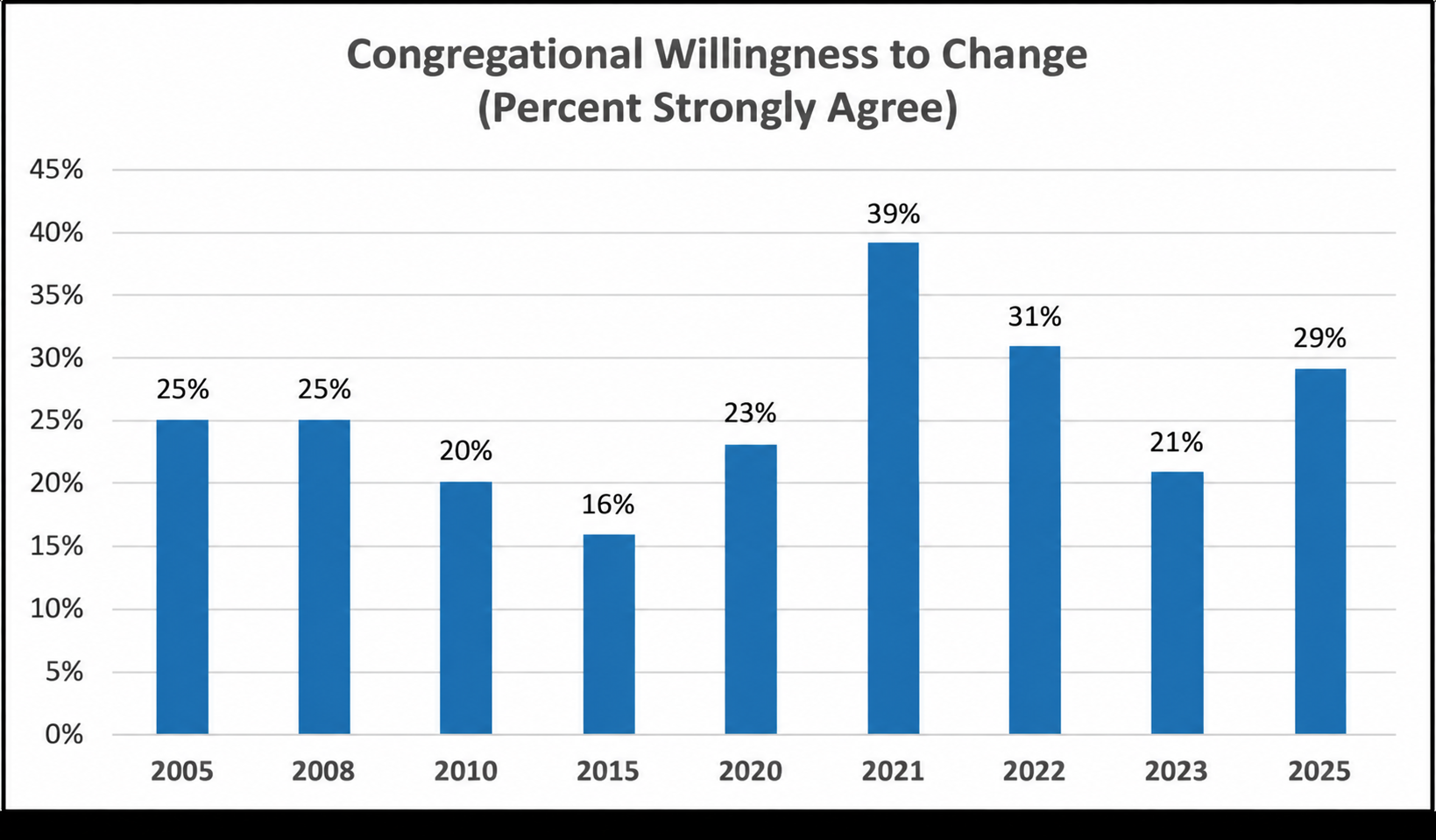
Norton and Thuma comment on these fluctuations in their formal report:
While openness to change has declined somewhat since those crisis years, it remains higher than it was before the pandemic. Many congregations continue to demonstrate a greater willingness to adapt than they did a decade ago. This raises an important question: which innovations were temporary responses to disruption, and which have become part of a congregation’s long-term identity? The report suggests that adaptability may remain one of the key factors shaping congregational vitality in the years ahead.
How we wish there was a gauge your church board could use to measure, on a daily basis, the openness to change that resides in your congregation. (“Our congregational barometer is plunging. Take cover – no change this month!”) Until that gauge is developed, however, church leaders need to find other ways to probe their congregation’s adaptability or capacity for change.
Perhaps one way to probe your congregation’s adaptability is to try changing something and watch what happens.
Organizational psychologist Adam Grant was interviewed this month in The Wall Street Journal on the changing nature of the workplace and how “to thrive now.” His observations are relevant to any church board that wants to work on adaptability.
WSJ: This is a tricky moment for white-collar professionals. What’s the issue?
Grant: Great careers used to hinge on ability, and now they depend on agility. The past was basically: Become a subject matter expert, define what you’re better at than everybody else and then that is essentially how you make yourself rare and valuable.
WSJ: And now?
Grant: The expertise you have today may be obsolete tomorrow…. So the differentiating skill set or capability is: Can you recognize patterns? Can you synthesize lots of disparate pieces of information? Can you figure out what perspectives are credible and which ones aren’t? All of that is a long way of saying that human judgment is going to supersede human expertise.
WSJ: What sort of daily habits would you put in place to do well in this new era?
Grant: In an ideal world, we all pick an experiment every week: I’m going to run a pilot, see how it goes, and then based on what I learn, I’m going to evolve my hypotheses and run another experiment next week.
If, as Grant observes, the world is moving away from ability toward agility, how might that shift be promoted in our faith communities? What “experiments” could we run to practice agility over ability, human judgment over human expertise?
There is an unwritten rule in most congregations that some areas of church life are roped off and not to be changed. These areas can be about worship, about staffing, about mission priorities, about who is in what seat, or countless other things. On the rope hangs a sign: “No questions allowed here.” These may be the most important places to start asking questions, in the age of agility – and a great way to find out about your congregation’s capacity for change.
What kinds of changes did your church make during the pandemic? Which of these were temporary disruptions? Which became integral to your congregation’s identity?
If you charted your church’s “willingness to change” over the past ten years, would your chart follow the same fluctuations as the Hartford chart? Where would it diverge?
How might you measure your congregation’s capacity for change going forward? Can you think of an imaginative way to probe and measure that capacity from time to time?
Where do you see a shift in emphasis from ability to agility in your own life? How about in the life of your church?
Why might human judgment be more important in the present era than human expertise? What does pattern recognition or the synthesis of disparate pieces of information have to do with the shift from expertise to judgment?
What are some areas of your church life that might be a good place to run a few experiments and test your congregation’s openness to change?


No Comments