
Late in the afternoon of June 7, 1926, an architect left his worksite and, as he did every day, made his way to Sant Felip Neri in the Gothic Quarter of Barcelona for prayer, confession, and mass. At 6:05 pm, approaching a street crossing, he spotted a tram and stepped back — directly into the path of another tram moving in the opposite direction. The second tram struck him with devastating force.
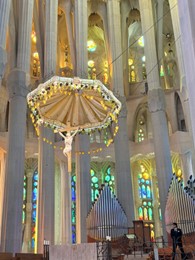 Based on of the elderly man’s unkempt appearance and lack of identifying papers, witnesses assumed he was a vagrant. Taxi drivers refused to carry him to a hospital. A police officer eventually obliged but, once at the hospital, the unconscious man received only the minimal care allotted to the destitute. It was not until the following day that a chaplain recognized him as Antoni Gaudí — the architect who had consecrated the last four decades of his life to building Sagrada Família. By then, Gaudí’s condition had deteriorated beyond repair. The artist whose greatest work was devoted to the poor —the building of a basilica he and others conceived of as a “Cathedral of the Poor” — died receiving the care accorded to the poor.
Gaudí never expected his grand design for Sagrada Família to be completed in his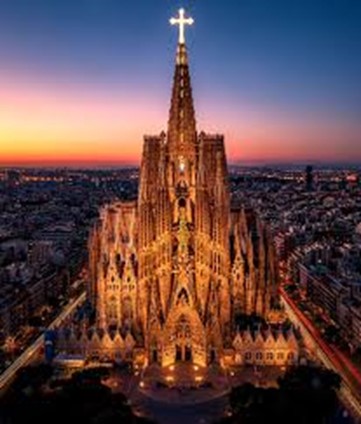 lifetime. And indeed, just this past February, in the year that marks the 100th anniversary of his death, the basilica reached its full height with the installation of a cross atop the Tower of Jesus Christ, making it the tallest church in the world. Years of work to complete the rest of the original design still lie ahead.
The construction of this basilica, dedicated to the Holy Family, has continued through 27 U.S. Presidencies, going back to Chester Arthur; 18 years of Queen Victoria’s reign; and all 70 years of Queen Elizabeth II’s reign. Its construction has continued through dozens of major wars and scores of regional conflicts, many still unresolved. Its construction has spanned Jim Crow and the scourge of racial violence and injustice in America; genocides in Nanking, Indonesia, Cambodia, Bosnia, and Rwanda; and the horrors of the Holocaust. The Berlin Wall has risen and fallen. Apartheid has been dismantled. We stood at the brink of nuclear annihilation and stepped back. We have gone to the moon, and this month, after a long hiatus, we returned. Across all these years the construction of Sagrada Família has continued with just a few hiatuses of its own.
The Spanish Civil War (1936–1939) was arguably the single most damaging interruption in Sagrada Família’s 144-year construction history. In July 1936, a group of young anarchists burned its crypt, destroying Gaudí’s workshop with his original drawings, photographs, and plaster models. The damage went far beyond stone and paper. Twelve people involved in the operation and construction of the building were killed amid the anti-clerical violence. Two years later, Domènec Sugrañes, Gaudí’s chief successor, died at age 59. Many blamed his death on the despair brought on by the bleak outlook for the project.
And yet, work on Sagrada Família has continued.
This work stands as a stubborn, faithful testimony offered by people who gave themselves to something far larger than their lives or hands could hold, people building for generations they would never know. Most of all, this work is a tangible witness that the future belongs to God.
We assume the building and grounds committee of your church board is not planning its own Sagrada Família. And yet the story of the Barcelona basilica speaks directly to whatever work you are about as a church. It speaks of:
+ Commitment to a vision of God’s grandeur—and to each small, faithful step that honors that grandeur. The work we do is hard. But a vision that is large enough carries us all forward.
+ The courage and steadfastness to persist, come what may. Day after day, year after year, God provides everything required for faithfulness.
+ Perspective on what really matters. Current board struggles over the location of the youth room, the future of the church bus, a balanced budget, a change in worship times … all pale in comparison with the enduring power of God to bring love, hope, beauty, and grace to the world God so loves.
In church life as in personal life, we are ever vulnerable to the pull of the urgent and the immediate. Sagrada Família stands as a reminder that our work in ministry needs to aspire to something larger and longer term that strives to match God’s vision for us.
In the following poem, Gerard Manley Hopkins (an English poet and rough contemporary of Gaudí) offers his own searing vision of God’s grandeur—and his perspective on what really matters.
God’s Grandeur
The world is charged with the grandeur of God.
It will flame out, like shining from shook foil;
It gathers to a greatness, like the ooze of oil
Crushed. Why do men then now not reck his rod?
Generations have trod, have trod, have trod;
And all is seared with trade; bleared, smeared with toil;
And wears man’s smudge and shares man’s smell: the soil
Is bare now, nor can foot feel, being shod.
And for all this, nature is never spent;
There lives the dearest freshness deep down things;
And though the last lights off the black West went
Oh, morning, at the brown brink eastward, springs —
Because the Holy Ghost over the bent
World broods with warm breast and with ah! bright wings.
When you think about the grandeur of God, what words or images first come to mind?
How is the story of Sagrada Família ‘a tangible witness that the future belongs to God?’
How would you describe Hopkins’ vision of God’s grandeur? What words or images stand out to you in his poem? What does the Holy Ghost have to do with it?
What vision of God’s grandeur underlies the life and work of your congregation?
How is this vision kept in front of your church board, amidst the urgent and immediate?
No Comments