

The mounting daily fatigue so many of us live with is not merely a consequence of busyness or complex work-life balance, but the pervasive and unrelenting false promise that there is always one more way to perfectly optimize your life. The message is that if you don’t choose correctly from the seemingly endless array of options, you will miss out on real satisfaction and meaning.
Over two decades ago, in Paradox of Choice, Barry Schwartz described it well;
“Learning to choose is hard. Learning to choose well is harder. And learning to choose well in a world of unlimited possibilities is harder still, perhaps too hard … We have too many choices, too many decisions, too little time to do what is really important.”
In our intensely media-driven, digital (and now AI) age, what Schwartz observed has rapidly accelerated. We are awash in “overchoice,” immersed in the illusion of endless options and constant access to everything (especially, but not strictly, among the economically advantaged). As Bo Burnham put it in his comedic tune, “Welcome to the Internet,”
Could I interest you in everything all of the time?
A little bit of everything all of the time?
Apathy’s a tragedy, and boredom is a crime
Anything and everything, all of the time
The result? Anxiety, analysis paralysis, a constant sense that we are missing out on something more satisfying, and despair when we realize some of our ideals are illusory.
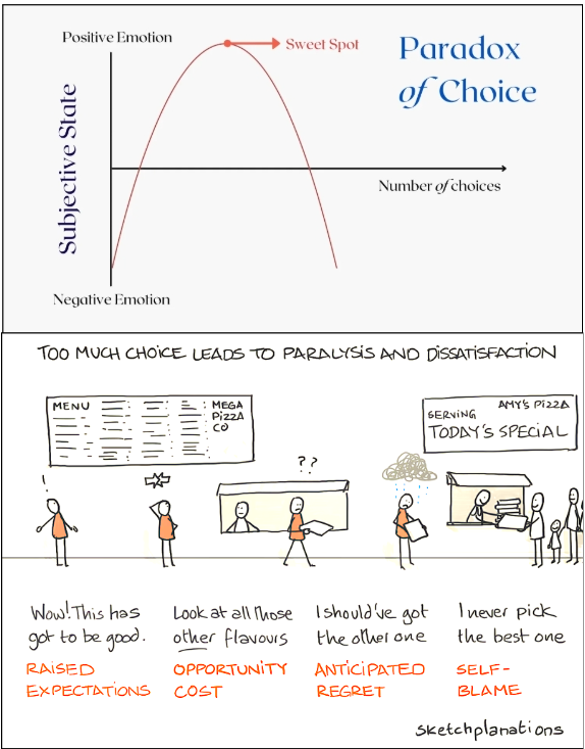
Ministry leaders inadvertently reinforce this soul‑crushing cycle when we assume the best response to restlessness is more programs, more access points, more content, more “stuff” on the calendar. If people seem disengaged, offer another option; if attendance dips, create another shiny thing; if commitment weakens, lower the expectations. Discipleship becomes preference management.
This is where Morgan and Barden’s A Beautiful Constraint can prove especially valuable. Beyond helping us to leverage existing constraints (instead of, “How do we get rid of this limit?” we ask, “How might this limit become the very thing that clarifies our calling?”), they also urge us to create constraints. Doing so helps us disrupt “path dependence” – the inherited assumptions and patterns of “how we’ve always done it.” When we choose constraints like fewer programs, a smaller array of practices, a more disciplined congregational rhythm, we are not capitulating to scarcity but forcing our imagination to step off the well‑worn path and discover more focused, faithful ways forward.
Yes, this is delicate work. People will be annoyed, frustrated, disappointed. And yet, ultimately, the process and results can prove life-giving. As Rick Rubin recently wrote,
“Consider what kind of limitations might serve your work…. Begin creating within these self-imposed limitations. Notice how the rules shape your decisions. Do they push you toward solutions you wouldn’t normally consider? Do they eliminate options in ways that clarify your choices? Pay attention to what emerges. Sometimes constraints reveal preferences you didn’t know you had. Other times, they force you into territory that feels uncomfortable but leads to surprising results.”
Consider the following examples and note how these are not about the “right” or “wrong” approach, but about creating constraints that help us focus and go deeper.
- Clarifying how your staff and volunteers talk about the identity, practices, and calling of the congregation (and how not to).
- Structuring the church calendar around a few recurring anchor practices, and being willing to say no to new ideas, even if they sound interesting or exciting.
- Limiting corporate worship expressions, inviting the congregation to be formed by shared liturgy more than individual preferences.
- Capping the number of one‑to‑one pastoral meetings per week and equipping layleaders to carry the rest.
- Choosing a geographic boundary for focusing outreach.
- Aligning all ministries with a few theological convictions (e.g., hospitality, reconciliation, evangelism) and saying “no” to good opportunities that do not fit.
My colleague John Harrison recently shared with me that his professor, Cynthia Rigby would frequently remind him, “finitude is not a sin.” Amen. The Incarnation shows us a God who assumes human limits so that divine love is revealed inside finitude, not beyond it. And the church as Christ’s body means that differentiated, particular gifts are part of our calling. Honoring our limits, and even choosing some of them, is not spiritual failure but a faithful way of living a finite, creaturely existence, where grace works through particularity.
Pastors are always making a choice about choices. We can reinforce the liturgy of “your way, right away,” or we can choose our constraints, trusting that fewer, deeper, more deliberate practices may be where a deeper freedom, faith, and spiritual maturity become possible.
Questions for Reflection:
- Where in your current ministry do you most feel the pressure to “expand the menu,” and what is one concrete constraint you could choose there for the sake of deeper, more faithful work?
- In your own life and ministry, where do you still experience your limits as failure rather than gift, and how might the incarnation, Sabbath, and “finitude is not a sin” reframe those limits as part of your calling?
- If your congregation were to adopt one or two “beautiful constraints” over the next year (for example, in calendar, discipleship pathway, or mission focus), what might they be, and what resistance or hope do you anticipate if you tried to live within them together?


Albert E. Russell
Posted at 09:25h, 02 JulyWe recently did our yearly review. One of the questions on the exit survey was “does the church offer enough programming for you?” This article is clarifying. We’re a small congregation with a handful of people looking for a light show and a coffee bar, etc. What the church needs is more people willing to lead and strengthen what we have. Everyone is just comfortable showing up and going home. Thank you for this!