


Did you see this snafu at a recent Arizona college graduation? An AI system that was supposed to read graduates’ names at a ceremony malfunctioned, skipping and mispronouncing names, robbing many students of their once-in-a-lifetime moment of recognition. This was predictably followed by boos and an awkward apology. With a view toward optimization, the institution traded the slow, inefficient work of human attention for automation, illustrating how seductive it is to treat even our simplest human rituals as problems to be engineered away. A human voice calling your name, however imperfectly, carries presence and purpose, saying, “I see you; you belong here.” The AI voice sounds perfect, until it exposes how our drive to optimize can render people invisible precisely at the moment they are meant to be most seen.
The incident speaks to what I wrote a few weeks ago about living in the “age of the actual.” People who have grown up immersed in a simulated, virtual, and now AI world are increasingly longing for what is real, what is actual. They are not asking, “Does this look, sound, or feel authentic?” so much as, “Is this actually happening, with actual people, in an actual place?” Having received a multitude of responses, I’ve been reflecting more on how The Age of the Actual shift reshapes how congregations understand their relationships with the communities around them.
Witness as inefficiency
One of the dominant temptations in congregational life is to be a well-oiled machine in which every ministry program is streamlined, scalable, and efficient. With the noblest of intentions, we want clear metrics, visible outcomes, and ministries that can be organized, repeated, and explained with minimal friction. Simply put, we want a return on investment.
And yet much of what it means to be human and to exhibit a patient, faithful “long obedience in the same direction” refuses this logic. A congregation’s life with its neighbors often unfolds through the slow accumulation of presence: friendship with a school principal, consistent attendance at local civic gatherings, frequent engagement with local business owners and grocery store employees, meals where nothing dramatic happens except that trust is slowly built. This kind of witness is wasteful by institutional standards because it consumes time, energy, and attention without always producing obvious results. (It reminds me of theologian and author Marva Dawn describing worship as “A Royal Waste of Time.”) Through the lens of our culture, it’s a waste because it’s oriented toward meaning making and relationships that may or may not be measurable. Real people do not move at the speed of strategy. In that sense, inefficiency is not simply a weakness to be managed, but a mark of Christian witness in an age of longing for that which cannot be automated or simulated.

Witness as inconvenience
The broader culture is already documenting the risks of our convenience addiction.
As Psychotherapist Alex Curmi worries,
“Modern hyper-convenience is a kind of deal with the devil. It is seductive because it appeals to our instincts, but it surreptitiously depletes us. It has made it easier to get by, but in many ways harder to truly succeed. Human flourishing and happiness is not just about subsistence, but also depends on growth, dynamic problem-solving, and solidarity through hardship.”
Moreover, a recent NIH study links the growth of convenience
“with erosion of values and depletion of the diversity and richness of personal experiences.” …. “Convenience therefore operates as a veil; it masks the disposal of positive traits to create an enticing iteration of a product or service with a time and/or effort saving. It sanitizes our interactions and risks reducing the quality and quantity of interpersonal relationships and human interactions, both in a conceptual and practical sense.”
Gospel witness is often inherently and necessarily inconvenient. Why? Because the gospel is stubbornly particular. It binds us to places, to names, to histories, to people we did not choose and cannot control. It is about accepting the inconvenience of shared life in a real place. My friend and colleague Kris Rocke of Street Psalms, responding to my last piece, puts it this way: “my relationship to those at the margins remains the most reliable short cut to reality…what little I know about being human can be traced there.” The people who live most vulnerably at the edges of our systems tend to puncture our illusions first. If we want to know what is actually real in our communities and respond faithfully, we need to start there, at the margins. What we will find is that the most vulnerable people and vulnerable communities do not allow us to remain generic. They confront us with realities that cannot be solved by branding, projected relevance, preferred narratives, flawlessly run programs, or borrowed models from somewhere else. They force us into the particular. The particularity matters, because if ministry can be fully designed apart from the stubborn, unpredictable presence of actual neighbors, then it probably belongs more to the age of the machine than to the age of the actual.
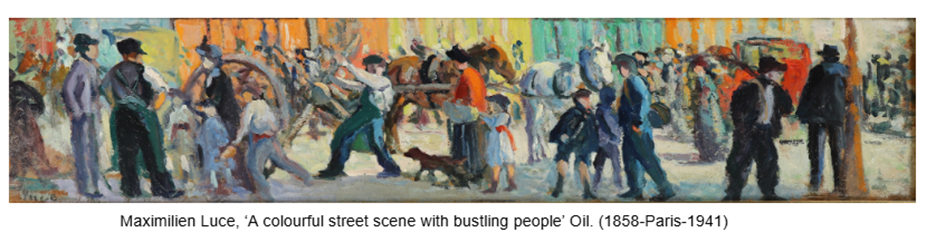
Witness as interruption
Perhaps the simplest test of a church’s relationship to its community is this: are we interruptible? Are we known enough, near enough, and available enough that our neighbors can make claims on us? This is a far more difficult question than whether a congregation is admired, visible, or even generous. A congregation can be respected in the abstract and still remain untouched by the actual demands of the place where it exists. But witness in the age of the actual requires more than projection; it requires availability. Can the teacher at the school next door call someone from the church when things fall apart? Can a parent down the street imagine crossing the threshold not as a visitor to a religious event, but as someone entering a place where they can be known, welcomed, and loved? Can local leaders name the congregation as part of the fabric of communal life, rather than as a group that occasionally hosts things? These are questions of interruption, not image. This is one reason Jesus’ words, “Touch me and see” feel so important here. They name a mode of presence that is not afraid of scrutiny, contact, or demand. A church shaped by that posture will not only open its doors. It will become, in a deeper sense, touchable.
A Truly, Actually Shared life
The parables of Luke 15 are instructive for all of the above. By almost any institutional metric, the characters in these stories are irresponsible. A shepherd leaves ninety‑nine sheep in open country to hunt for one wanderer; a woman stops whatever “productive” work she was doing to sweep her house for a single coin, then throws a party that surely costs more than the coin itself; a father runs to embrace a son who has burned through half the family estate, robes him, rings him, and kills the fatted calf as if the books had never been broken. No one here is optimizing or managing risk. They are simply refusing to lose track of someone they love. As such, these are not examples of bad stewardship but of a different economy altogether, one that cannot be captured in a spreadsheet because its basic unit of value is not output, reach, or return on investment.
Our systems are trained to ask, “Is this worth the time and investment?” Jesus keeps asking, “Is this one worth my Father’s love?” The real calculus is not “What will this do for the bottom line?” but “Who is missing from the table, and what are we willing to set aside so that we can all feast together?”
We are therefore faced with challenging questions that cannot remain hypothetical but must be made concrete: which meetings, which line items, which long-standing programs are we willing to sacrifice to be interruptible, inconvenienced, and faithfully inefficient? Which forms of polish and control can we relinquish in order to pursue a deeper gospel witness that might be interpreted by some as a “waste” of time, energy, and resources?
Witness in an age of the actual will sound simple and costly: you can call, you can come by, we will be here, we will call you by name. This has to be true not only of congregations but of the individuals who participate in congregational life, deciding each day whether their lives will be interruptible, available, and a little less optimized than the culture demands. If a congregation cannot wrestle honestly with these costs in its own neighborhood, the message probably won’t matter. In our “communicational crisis,” the world is understandably less interested in messages, statements, and performative slogans. What it is still wondering is whether anyone is willing to live without the protective distance that keeps us from one another.
Taken together, inefficiency, inconvenience, and interruption point toward an alternative imagination of witness, suggesting that a congregation’s calling in the community is not first to market itself effectively or implement impressive initiatives, but to become a people with whom neighbors can share in our inescapably fraught, gritty, complex human reality. This will mean listening before speaking, joining what is already happening before starting something new, and valuing forms of faithfulness that are difficult to quantify. It will mean refusing to treat neighbors as audiences, constituents, clients, recipients, or even potential congregation members, learning instead to receive them as fellow laborers in a shared place and time for the common good.
—-
For group discussion, consider the questions embedded in the essay.



Sarah Sarchet Butter
Posted at 08:38h, 02 Junethank you for this article, its insights, invitations, and challenges call to me.
Adam Borneman
Posted at 17:22h, 02 JuneThanks, Sarah! Hope you’re well.