

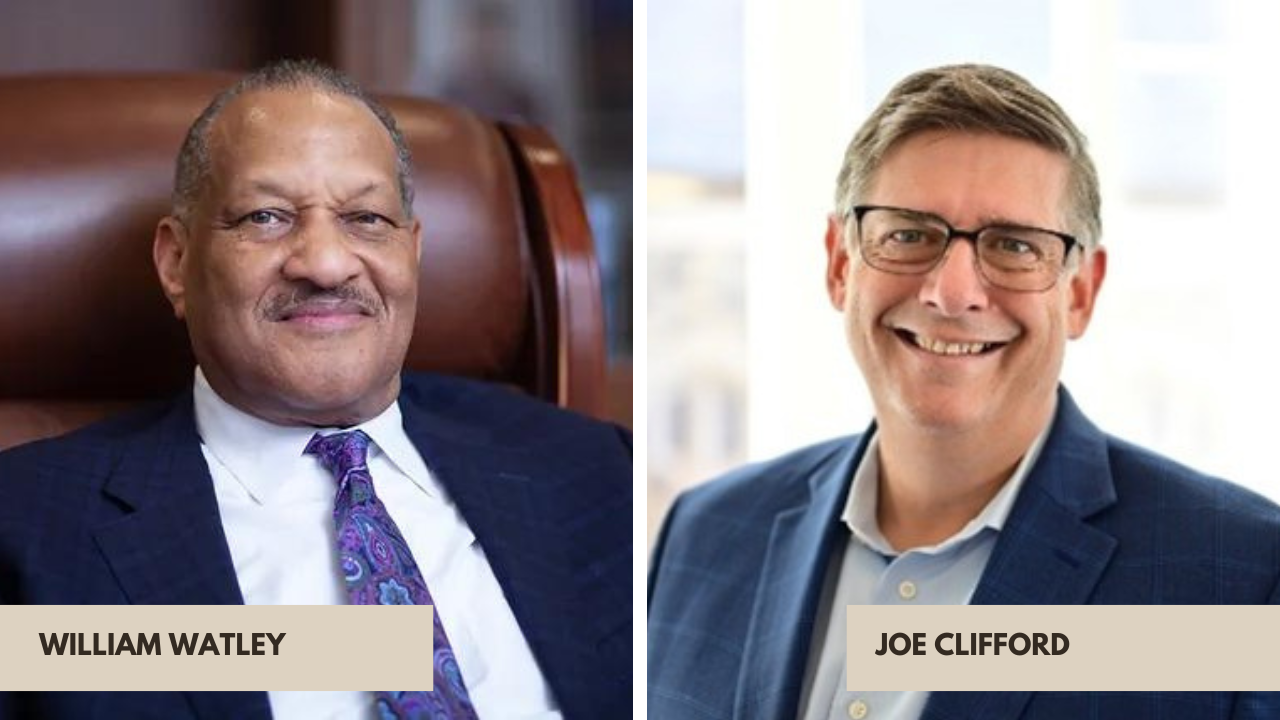
In this conversation, Amy Valdez Barker speaks with Dr. William Watley, renowned AME pastor, preacher, author, and senior advisor to TMC cohorts focusing on preaching, and Rev. Joe Clifford, pastor of Myers Park Presbyterian Church in Charlotte, and a longtime facilitator with TMC. Together they reflect on the challenges and possibilities of preaching today, emphasizing the centrality of Scripture, the enduring power of the cross, the need for deep preparation, and the task of helping people encounter the holy in a distracted, suspicious, and biblically unfamiliar age.
Amy: There is so much diversity when it comes to preaching, and we know one size does not fit all. When you think about preaching today, what would you say are two or three essentials for preachers to keep in mind?
William: I’ve been preaching now for 64 years. There was a time when people listened almost unquestioningly and looked forward to the time of preaching. Now there is a hermeneutic of suspicion. Secondly, the use of technology means that people can fact-check you. We have to be particularly careful about what we say, because people do not mind pulling out their cell phones and checking. Third, one has to have an attention grabber. There was a time when you could take your time and build a biblical case, but the attention span of both this coming generation and now my generation means that people do not have all day for us to get to the point. They are asking themselves, “Do I really need to take my time to listen to whatever it is this person has to say?”
There are a couple of other concepts that I really believe define Christian preaching, and one is the cross. I was brought up to believe that a sermon is not complete unless, in some way, the cross is mentioned. “I came to you claiming nothing other than Christ crucified.” To me, that still seems to be a radical aspect of the faith that we sometimes overlook, because we have made it a religious decoration that we wear, rather than the means of God’s love, Christ’s redemption and forgiveness, and the promise of a quality life as eternity becomes our everyday reality.
Joe: It’s tough to add to that wisdom. I think the centrality of the Word in preaching is key. We must stay in the Word. The Word is what gives our preaching power. When we connect to the power of God experienced within the Word of God, that’s what preaching is. That’s what differentiates preaching from public speaking or a TED Talk. There is a temptation to mimic the culture, and for preachers I think that is a tragic error, because we cannot compete. But nothing can compete with the power of God’s Word. The more we can stay in that and proclaim it, the more faithful our preaching will be.
The challenge is that we are an increasingly biblically illiterate society. I know when Dr. Watley says, “I come to proclaim Christ crucified, and him only,” he’s drawing from 1 Corinthians, and I know the context of that, but 98 percent of the people in my congregation have no idea what that means or where that’s from.
So on the one hand, we have this challenge to stay in the Word, because that is the source of our life and power. Yet we are doing that in a community where very few people know much about Scripture. I’m always stunned by what people do not know is in the Bible. We did an eight-week series on the minor prophets, and all you had to do in that series was read the Scripture, and you could hear a pin drop in the sanctuary as people were hearing these words. The power was there. Dr. Watley raises a great point about people’s attention spans and what it takes to bridge that. I think the third focus is that you have to say something that can get people’s attention. Within the Word, there is a lot there. I think it is our job as preachers to lift that up.
William: I think it’s important that we take preparation seriously and ask questions of the next generation without assuming that they know what we’re talking about, or that we know what we’re talking about. One of the freedoms of not pastoring is spending more time. Even as a pastor, I had a daily devotion, and now it is even more critical, because people do come to find out if there is a word from the Lord. In my community especially, with the leadership that we have, and the number of Black Christians who were praying that he not get elected, what does it mean now that he is?
There is a crying, unspoken request for a word from the Lord that empowers and gives hope. To come up with that means that we really have to look at issues of preparation and the time it takes. After 64 years, I still write my sermons out word for word, and it takes me eight to ten hours to do so. In this day and age, when there is so much celebration and mimicking of the ways of the world, the sense of the sacred has to be consciously fostered, and it begins with us, our own prayer time, and preparation as we get ready to say a word from the Lord.
I was saying to one of the youngsters, “I really had to work hard.” She asked me, “What kind of work did you do?” I said, “Well, I sold encyclopedias.” She looked at me and said, “What’s an encyclopedia?” Which says something about the gap, and how we have to be conscious of crossing the bridge into terrain that people know nothing about, or little about, and into their world that we know little about.
Joe: Yet it’s exactly what they’re searching for. That longing hasn’t changed. The longing within us to connect with the sacred, and to get into the depths of life that we find in relationship with God, is imprinted in our souls. That is true for people who do not know what an encyclopedia is. I feel like we have what they’re looking for, and they do not even know they’re looking for it, but it is to be found in relationship with God. I think preaching is an invitation into that.
I didn’t grow up in church, and my first interaction with weekly preaching was in my twenties, with a pastor, K.C. Ptomey, at Westminster Presbyterian in Nashville, Tennessee. I do not remember any of K.C.’s sermons particularly. I do remember that every Sunday I left feeling like I had had an encounter with the Holy, and K.C.’s preaching facilitated that. For me, that is what we are trying to facilitate in our preaching. We are trying to connect people and their lives to the truth of God, the reality of God, and where God is amid whatever is happening in their lives, whether it is political turmoil, a spouse’s cancer diagnosis, or a child’s suffering. Where is the Holy in that? To the degree that our preaching can facilitate that connection, I think it is faithful.
Amy: What are some of the practices do both of you use in preparing to invite people into that kind of encounter?
William: It is an everyday consciousness of looking for a word from the Lord. We get the text, and then we think it through. If my sermon is Sunday, I set aside sermon preparation days, Wednesday and Thursday, when people knew not to call me unless it was an emergency. As we embody and seek a word from the Lord, we also listen to the language and style of those we are trying to reach in order to foster a legacy that brings forth the message. It has to be done consistently.
Joe: I agree with all of that. An important piece of preparation for me is that I lead a couple of weekly Bible studies with different groups of people in my church. I hear how they hear. I ask what their questions are when they hear this Word. That helps me get a sense of what people in church on Sunday are wondering when they hear me read Joshua 24. It gives me insight into ways to get into the text that might work for my congregation. There might be things that are interesting to me, but my people do not care about them. So in addition to sacred time of preparation and study, I think it is important to engage your people and get a sense of how they are hearing.
Amy: Excellent. Thank you both so much for taking the time to share your wisdom and your experience with us. We are richly blessed by both of you and the leadership you are providing in our cohorts and across the world. God bless you.
No Comments