


One of my most significant callings as a father is to make sure my children understand the real value of the internet.
So naturally we watch a lot of funny cat videos on YouTube.
On one such occasion, my eight-year-old chuckled at some absurd cat behavior, turned her head toward me and asked, “Is this AI?” It wasn’t. But the question stayed with me. We have entered a moment when nearly everything we observe on a screen feels uncertain, when simulation is assumed and reality must prove itself.
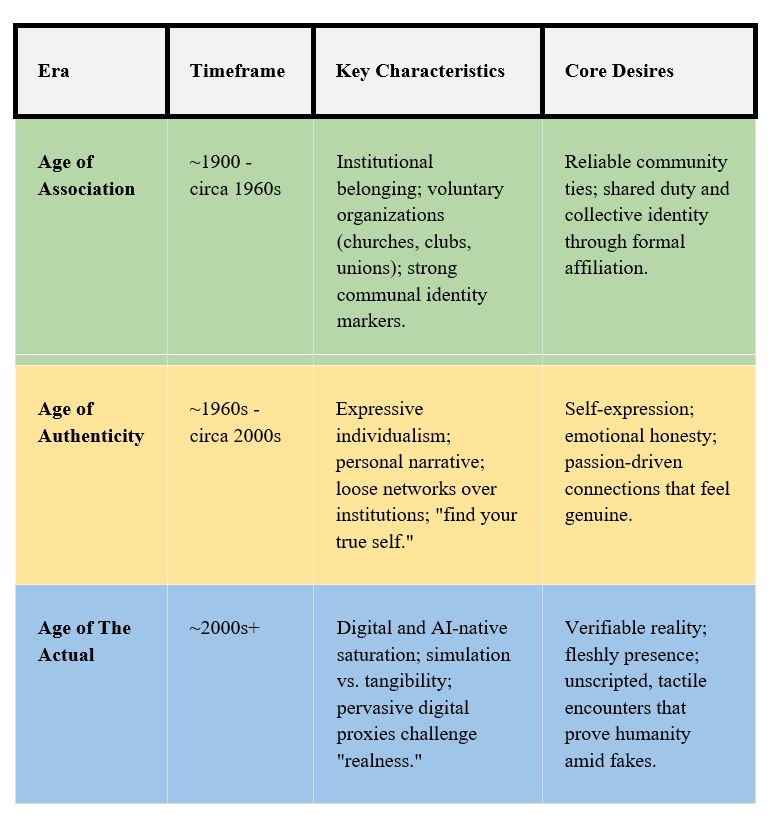
Theologian Dwight Zscheile observes that prior to the 1960’s, American society lived in the age of association, when people found meaning through institutional belonging, churches, clubs, civic organizations. The era that followed he calls the age of authenticity, in which the focus is discovering and expressing oneself. It’s an age where “identities are understood not to be ascribed but constructed and performed by individuals through a series of choices.”
In many ways, we are still in this age. But I’m left wondering, what new language might help us more precisely name the forms of desire and belonging emerging in the generation now coming of age?
 Born into a pervasively digital and now AI world of online simulation and algorithmic optimization, Gen Z and Alpha appear to be pioneering the Age of the Actual, marked by a hunger not for institutional identity markers or curated performance, but for what is unmistakably real. Immersed in digital proxies, this generation frequently asks, “Is this human?” Without rejecting an increasingly digital world and the necessity of engaging it, it’s a generation that nevertheless seeks experiences that can’t be coded and which no algorithm can fabricate.
The data bears this out. A recent Harris Poll proclaims “Physical > Digital,” and describes a “return of touch,” finding that people are actively seeking physical, shared experiences they report as more authentic than digital ones. Psychologist Clay Routledge finds that 68% of Gen Z report nostalgia for eras before their lifetime, with two-thirds saying it helps alleviate anxiety about modern life, driving their embrace of vinyl, physical books, and board games. And 26-year-old writer Freya India captures the mood directly: “I realize now that I want to be real. I want to say what I actually think and feel, even if it’s awkward or wrong or confusing. I don’t want to sound like predictive text. I don’t want to be harmless and agreeable and optimized. I want to be human… willing to offend and move and confuse people… starting sentences no algorithm could finish.” Ted Gioia calls it, “The New Cool Thing: Being Human.”
My daughter’s question is perhaps emerging as the dominant question of her generation: Is this real? Is this human? Is this actually happening?
The ache for what is unquestionably real is, at its root, an ache for the Incarnation. It is the soul’s recognition that truth, love, and even God are not abstractions to be streamed or simulated, but realities made known in flesh and time. What will it look like in the Age of the Actual for my daughter to “taste and see that the Lord is good,” to “touch the hem of his garment”?
Something in the resurrection stories keeps catching me. When Jesus appears among the disciples, they wonder if they are seeing a ghost, something less than what appears, something not quite verifiable. Jesus simply says, “touch me and know.” When Thomas voices the same doubt, that unless he can see the wounds and touch them himself, he will not believe, Jesus doesn’t shame him for wanting something tangible. He invites him closer. “Put your finger here and see my hands. Reach out your hand and put it in my side. Do not doubt but believe.” The risen Christ doesn’t answer doubt with more data, clever explanations, or virtue signaling. He answers it with presence. In Luke 24, after Cleopas and his companion don’t make the connection between what the scriptures say about resurrection and that it’s the risen Jesus talking to them, it’s in the experience of the tactile and multi-sensory that reveals the truth. “When (Jesus) was at the table with them, he took bread, gave thanks, broke it and began to give it to them. Then their eyes were opened…” Here we are reminded what the act of knowing the truth entails: personal, relational, organic, embodied, textured, akin to what Michael Polanyi famously described as “personal knowledge.”
Faith reaches for something it can hold.
The hunger of the Age of the Actual is not a problem for the church to solve. It is an invitation the church is uniquely positioned to answer, not by resisting technology or uncritically embracing it, but by being unmistakably human. Congregations have on hand the raw theological material and the time-honored practices of koinonia to nurture a way of life together in which people are truly known and explicitly told they belong, where specific names and specific stories matter, where presence is intentionally practiced as a non-negotiable of mission and evangelism, where spectacle is pushed aside for the sake of encounter, and where creating avenues of creative expression is prioritized as a witness to God’s good creation.
The church’s vocation has never been to outpace the technologies of its age, but to inhabit time and space in a way that exhibits what unmistakably human life with God can look like. To become more like Christ is not to escape our humanity but to inhabit it more deeply, and in doing so encountering what it means to be fearfully and wonderfully made by God. Ministry in the Age of the Actual will not be defined by our statements about reality, but by the concrete ways we encounter, experience, and share reality, specifically the reality of God’s love for us in Jesus Christ. This will require a shift in our imagination, framing, and discernment of what sustainable cultivation of faith looks like. Here are a few ideas to nudge us in that direction:
Ten questions for evaluating current and potential ministry efforts in the Age of the Actual.
- Does this make us more unmistakably human, or less? In a world saturated with simulation, automation, and disembodied information, the church’s most prophetic act is to be palpably, irreducibly human.
- Does this emerge from the actual lives of real people in this congregation, or from a template someone else created? Borrowed programs and packaged curricula can be useful, but ministry shaped by the specific griefs, joys, and questions of particular people carries a weight that generic content cannot.
- Does this make people more known, or just more reached? There’s a difference between scale and depth. A strategy that touches many people lightly may be less valuable in this cultural moment than one that knows fewer people deeply.
- Does this require a human being who cannot be replaced? Not just a warm body, but someone whose specific presence, history, and relationships make the ministry possible. If anyone could do it, or no one needs to, that’s worth noticing.
- Does this slow people down rather than speed them up? The church’s distinctiveness is inefficiency, that is, the unhurried texture of presence, attention, and shared time. Initiatives optimized for convenience may be moving in the wrong direction.
- Does this create conditions for unscripted moments? The most formative ministry often happens in the margins, i.e. after the service, around the table, in the parking lot. Initiatives that are too tightly controlled may be crowding out the moments that matter most.
- Does this ask something of people, or only offer something to them? Consumption is easy to automate. Genuine community requires contribution, vulnerability, mutual obligation, and other values that resist optimization.
- Does this form people, or merely inform them? Information can be delivered endlessly and cheaply. Formation requires time, repetition, relationship, and embodied practice.
- Does this depend on the particular place and community where it is happening? Ministry that could be lifted out and dropped into any congregation anywhere may be missing the point. The church’s calling is not to scale a program but to be faithfully present to specific people in a specific place.
- Does this reflect Jesus’ invitation to “touch and see”, or does it keep people at a distance? “Actual” ministry is an invitation into contact with God, with one another, with the unscripted friction of actual life together. The risen Christ did not offer an idea. He offered himself.



No Comments