


“When God made His promise to Abraham, since there was no one greater for Him to swear by, He swore by himself, saying, ‘I will surely bless you and give you many descendants.’ And so after waiting patiently, Abraham received what was promised.
People swear by someone greater than themselves, and the oath confirms what is said and puts an end to all argument. Because God wanted to make the unchanging nature of His purpose very clear to the heirs of what was promised, He confirmed it with an oath. God did this so that, by two unchangeable things in which it is impossible for God to lie, we who have fled to take hold of the hope set before us may be greatly encouraged. We have this hope as an anchor for the soul, firm and secure. It enters the inner sanctuary behind the curtain, where our forerunner, Jesus, has entered on our behalf. He has become a high priest forever, in the order of Melchizedek.”
Hebrews 6:13-20, NIV
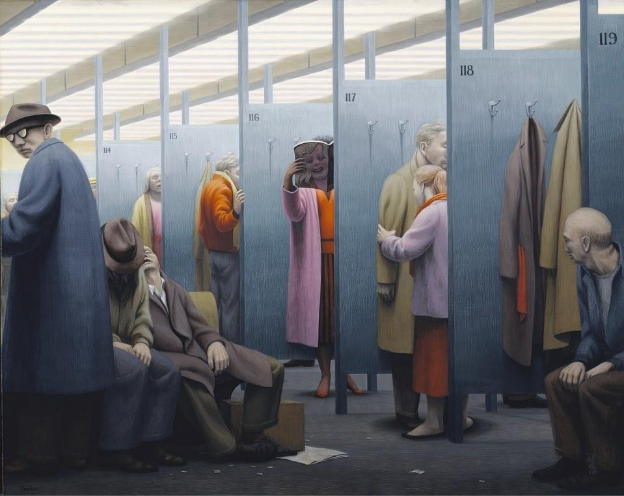
George Tooker, The Waiting Room, 1959, egg tempera on wood, 24 x 30 in. (61.0 x 76.2 cm.), Smithsonian American Art Museum, Gift of S.C. Johnson & Son, Inc., 1969.47.43
A pastor of a small congregation near Las Vegas shared how her church, after listening, observing, and waiting on the Holy Spirit, began a family worship service for families with neurodivergent members and children with special needs. Designing it was challenging because it had to be fluid and flexible enough to meet a wide range of needs and welcome full-bodied participation.
One Sunday, a family brought a young woman who, in other churches, had been asked to leave for being “too loud.” Here, everyone knew worship could be loud or quiet, still or moving. That day, she yelled for twenty minutes straight. The pastor made space for her voice, waited until she settled, then continued with communion. Afterward, her mother, with tears in her eyes, said, “No one has ever waited for us before. Thank you.”
Waiting rarely brings the best out of us. Standing in line at an amusement park for hours for a two-minute ride, sitting in a restaurant as your food takes too long, or waiting for someone who is late can quickly stir impatience, frustration, and anger. Our culture has trained us to expect instant gratification. We no longer wait in line for groceries; we use Instacart. We no longer have to spend time in any store; we click a button and expect delivery at our doorstep the next day.
Participating in church life is no exception. We grow annoyed or anxious when the preacher goes past the allotted twenty minutes, checking clocks on our phones and getting distracted by apps to numb impatience. Frustration can arise when a pastor’s vision unfolds more slowly than we hoped, or when a ministry feels repetitive rather than exciting. Impatience may emerge from wanting discipleship to offer quick takeaways rather than deep, lingering teaching. The same attitude can surface in service and outreach, where a lack of immediate impact leads to disengagement, or in spiritual growth, where the quiet work of prayer, study, and community is abandoned when change does not come quickly.
How do we reconcile, “it is impossible for God to lie” (Hebrews 6:18), when it feels like God has not kept God’s side of the promise? How do you wait for peace when wars in Ukraine and Russia, Israel and Palestine, drag on? How do you wait for food to feed your children when standing in line could mean death? How do you wait for change when no one seems willing to listen to those who disagree? How do we trust that God will keep God’s promise? Will it be in our lifetime? Will we know when it happens? Waiting can feel like hope is fading, as if unanswered prayers mean God is absent. Rather than wait, we often turn away. When things do not go as planned or expected, it can feel easier to leave, to abandon hope.
Hebrews reminds us that God’s nature is unchangeably faithful, patiently waiting for those God created to respond. Abraham learned that by waiting patiently, he received what was promised; his waiting was a vital expression of hope.
In a culture addicted to optimization and efficiency, one of the greatest gifts congregations can offer is hope-filled waiting. Be the embodiment of Christ by waiting for and with each other on this journey of life and faith.
Waiting is a witness to Gospel hope, a witness to the certainty of God’s faithfulness.
QUESTIONS:
What ministry of “WAITING” have you or your congregation embarked on lately?
When have you taken the time to WAIT with or for someone?
How can we invite people in our faith communities to value, or even enjoy, the task of WAITING?

No Comments